Sustainable tourism has become the travel industry's favorite marketing term — stamped on hotel brochures, tour operator websites, and airline carbon-offset programs with equal enthusiasm and equal vagueness. Everyone claims to be sustainable. Very few define what they mean, measure whether they achieve it, or demonstrate the mechanism through which tourist spending becomes community benefit.
This matters because when everything is "sustainable," nothing is. The word loses power. Travelers who genuinely want their money to create positive impact cannot distinguish between greenwashing and organizations that actually deliver measurable change.
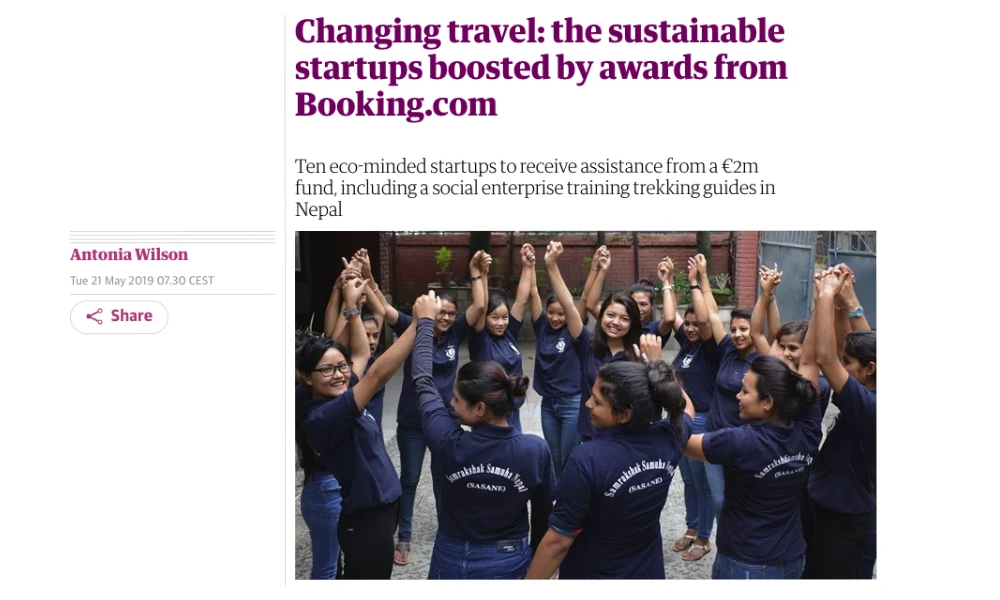
SASANE operates what independent evaluators have called one of the most rigorously measurable sustainable tourism models in South Asia. This is not a claim we make lightly — it is backed by third-party data, press coverage from The Guardian, recognition from the Sustainable Hospitality Alliance, and awards from organizations whose business is evaluating exactly these claims.
The Problem with "Sustainable Tourism"
Most tourism marketed as sustainable operates on one of these models:
Carbon offsets: Airline or tour company calculates carbon footprint, purchases offset credits, stamps "carbon neutral" on the brochure. The tourist's conscience is soothed. The host community receives nothing.
Eco-lodges: Premium accommodation built with local materials, solar powered, composting toilets. Genuinely lower environmental footprint. But staff are often minimum-wage employees with no ownership stake, profit flows to foreign investors, and the "community benefit" is limited to low-paying service jobs.
Voluntourism: Tourists pay to "help" communities — building schools, teaching English, working in orphanages. Research consistently shows that unskilled short-term volunteers often displace local workers, create dependency, and in the worst cases (orphanage tourism) directly cause the exploitation they intend to address.
Ethical marketing overlay: Standard tour operations add a paragraph about "respecting local cultures" to their website, donate a token percentage to a charity, and call themselves sustainable. No structural change to how business operates.
None of these models address the fundamental question: Does tourist spending create dignified, long-term economic opportunity for the people who need it most?
What Sustainable Tourism Actually Requires
Based on frameworks from the International Labour Organization, UNWTO, and independent researchers, genuinely sustainable tourism requires five measurable elements:
1. Direct Economic Transfer
Tourist money reaches local hands — not through trickle-down, not through "donations," but through direct employment, ownership, and economic participation. The people hosting, guiding, feeding, and transporting travelers must earn living wages with career progression potential.
2. Community Decision-Making Power
The community decides what tourism looks like in their area — what is shown, what is private, what level of development they want. They are not objects of a tourism product; they are its designers and operators.
3. Measurable Outcomes
Claims are backed by numbers that can be independently verified. Not "we support communities" but "X people employed, Y income generated, Z measurable change in community indicators."
4. Environmental Limits
Tourism volume stays within the carrying capacity of the environment. Growth is not unlimited. Degradation is monitored and managed.
5. Addressing Root Causes
Tourism that operates in regions affected by poverty, exploitation, or environmental degradation must address root causes — not simply extract aesthetic value from beautiful landscapes while ignoring the vulnerabilities of the people who live there.
SASANE's Model: Measurable Impact Tourism
SASANE was founded in 2016 specifically to demonstrate that tourism can be an anti-trafficking intervention — not just an economic activity that happens to create jobs, but a survivor-led travel company whose guides are trafficking survivors, its revenue bringing the next woman into the profession.
The numbers:
- 200+ survivors trained as certified guides
- 317 total jobs created across the organization and partner networks
- 22% reduction in trafficking rates across 11 partner communities where SASANE operates
- 4,900+ travelers guided since founding
- 6-month training program — not a 2-week course, but a professional transformation including language, safety, first-aid, cultural interpretation, and business skills
These numbers are verified by external evaluators and cited in award submissions reviewed by the To Do Award 2023 jury, the Sustainable Hospitality Alliance, and academic researchers.
How the Mechanism Works
- Recruitment: Women rescued from trafficking situations are identified through partner NGOs
- Training: 6-month comprehensive program including government guide certification
- Employment: Graduates lead professional treks and tours — ABC, EBC, Langtang, Kathmandu Valley
- Income: Professional guide wages — not charity, not subsidized, but competitive market-rate pay for skilled work
- Community effect: Employed women become economic anchors in their communities. Their families and neighbors see viable alternatives to migration and trafficking vulnerability
- Prevention: The visibility of successful survivors in professional roles changes community perception of what is possible — reducing the social conditions that make trafficking recruitment effective
The 21 communities rebuilt is not achieved by policing borders — it is achieved by demonstrating that women from these communities can earn professional incomes without leaving home.
How to Identify Genuinely Sustainable Operators
For travelers evaluating sustainability claims, ask these questions:
Who owns the business? If a tourism operation claims community benefit but is owned by investors headquartered outside the operating country, the economic structure limits how much actually reaches communities.
Can they show numbers? "We support local communities" is not a metric. How many people employed? What wages? What measurable change? Organizations with genuine impact are happy to share specifics.
What is the theory of change? How, specifically, does tourist spending become community benefit? Through wages? Ownership? Revenue-sharing? Supply-chain purchasing? The mechanism should be explicit and auditable.
Who decides? Are local communities consulted about tourism development? Do they have veto power? Or is tourism "done to" them by external operators?
What are the limits? Does the operator cap group sizes? Limit volume? Say no to revenue when it would exceed environmental or social carrying capacity? Willingness to leave money on the table for sustainability reasons is a strong authenticity signal.
Independent verification? Are claims validated by organizations without financial incentive to confirm them? Press coverage, academic research, and award juries with transparent evaluation criteria all provide independent verification.
The Anti-Trafficking Dimension
Nepal faces severe human trafficking challenges. The ILO estimates millions affected by modern slavery in South Asia. Nepal's geography — between India and China, with porous borders and extreme poverty in rural areas — creates conditions where trafficking recruiters exploit economic desperation.
Tourism that creates genuine economic alternatives in trafficking-source communities is not merely "responsible travel" — it is structural intervention in a human rights crisis. This is why organizations like Tourism Watch and Human Rights in Tourism have recognized the work done by SASANE Sisterhood to transform the whole concept of conventional tourism.
When you book a trek with SASANE, you are not "donating to charity while on holiday." You are purchasing a professional service from a certified guide whose employment represents one data point in a 21 communities rebuilt. Your payment is the mechanism of impact — not an add-on to it.
Read Sitashma's story for a first-person account of what this model looks like from the inside.
What Travelers Can Do
Beyond choosing operators carefully:
Ask questions. Operators making sustainability claims should welcome specifics. If they become vague or defensive when asked for numbers, that tells you something.
Pay fair prices. The cheapest tour is not the best value. If a guided trek costs dramatically less than competitors, someone in the supply chain is being underpaid. Fair wages require fair prices.
Engage with the experience. Ethical trekking means more than waste management — it means showing genuine interest in the communities you pass through, eating local food (Mo:Mo), learning basic Nepali phrases, and treating your guide as a professional colleague rather than a servant.
Share your experience. Reviews, social media posts, and word-of-mouth recommendations that specifically mention sustainable practices help other travelers make informed choices and reward operators who invest in genuine impact.
Travel with measurable impact →
What Our Travelers Say
"Great fun little class making the traditional Nepalese dumplings. This experience was made so much more meaningful because of the fantastic cause you are supporting. It really highlighted a huge problem which we are totally insulated from in the 1st World, that of human trafficking. The charity does some amazing work and I was humbled."
— Charlie B, Leeds, UK, TripAdvisor (February 2023)
Frequently Asked Questions
What is the difference between sustainable tourism and ecotourism? Ecotourism focuses specifically on nature-based travel with environmental conservation goals. Sustainable tourism is broader — it encompasses environmental, economic, and social sustainability. An ecotour in a national park may be environmentally responsible but economically extractive if profits leave the community. SASANE's model is sustainable tourism with specific anti-trafficking impact.
How do I know if a "sustainable" tour operator is genuine? Ask for specific numbers: people employed, wages paid, community outcomes measured. Look for independent verification — press coverage, award recognition, academic citations. Genuine operators welcome scrutiny. Greenwashers rely on vague language and resist specifics.
Does sustainable tourism cost more? Sometimes, but not always. SASANE's guided treks are competitively priced with standard tour operators — the difference is where the money goes, not how much it costs. Fair wages, community benefit, and professional training are built into the operating model rather than added as a premium surcharge.
Can mass tourism ever be sustainable? Volume and sustainability are in tension. Genuinely sustainable tourism typically involves some form of visitor management — group size limits, seasonal distribution, capacity caps. This is why SASANE operates at a scale appropriate to its guide capacity rather than maximizing volume. Quality of experience and depth of impact matter more than numbers processed.
What is impact tourism? Impact tourism is tourism explicitly designed to create positive measurable outcomes — beyond "doing no harm" (the sustainability minimum) to actively improving conditions for host communities. SASANE's model is impact tourism: each trip creates employment for trafficking survivors and contributes to measurable trafficking reduction.
How does tourism reduce human trafficking? By creating dignified economic alternatives in communities where poverty makes people vulnerable to trafficking recruiters. When women in source communities see survivors earning professional incomes as guides, the narrative changes. Migration (and its trafficking risks) becomes less attractive when local opportunities exist. SASANE's 21 communities rebuilt across 11 partner communities demonstrates this mechanism.